Tuesday, 22 October 2013

Oct. 22 – Currents and Circuits

Current Electricity and Circuits

Learning Goals: Understand how current flows through a circuit.

Success Criteria: You can describe the different parts of a circuit and recognize whether it is open or closed.

I'm madly marking away at your element assignments so please forgive me for a shorter blog post today.  Here are the handouts:


A common circuit with wires, battery, switch and bulb.
Keep in mind a circuit is like a roller coaster:
A circuit is like a roller coaster.  A chain (battery) starts the roller coaster (electrons) moving and they go all the way around the track (wires). 


Homework: Questions listed at the bottom of the handouts.

Monday, 21 October 2013

Oct. 21 – Discharges

Reminder: there is a quiz on Thursday, Oct. 24!  It will cover all of chapter 11.  Here are the quiz topics:

Handout: Chapter 11 Quiz Topics

Discharges

Learning Goals: Understand how electrical discharges occur.

Success Criteria: You can describe examples of electrical discharges and explain how they occur.

This is the final topic from this week that will be on the quiz: discharges.  When a lot of charges build up, they can jump from one object to another.

Discharges: The rapid transfer of electrons from one object to another.

Examples: being shocked by a doorknob, lightning, tasers, unplugging outlets.


Here are some amazing photos of lightning storms:

Do you think lightning moves up from the Earth to the clouds or down from the clouds to the Earth? The answer is a little of both.  Sometimes lightning even goes from clouds to clouds.

Here are some videos of electric discharges.
WARNING: All of these are incredible dangerous situations!  Always be cautious around electrical power sources.

The movie "Like Mike" makes it look like you get magical powers from being shocked.  In real life, you would probably die.  Again, I repeat, be extremely cautious around electrical power sources!

Next we worked on some questions regarding electrostatic applications.  These questions will help prepare you for the quiz.


Homework: Complete the handout.

Friday, 18 October 2013

Oct. 18 – Conductors and Insulators

A lot of people seem to have trouble completing the lab yesterday so I have offered an extension!  You may hand in the lab on Monday without penalty.  Make sure you take the time to complete it well.

I also announced that there will be a QUIZ on Thursday, Oct. 24.

I handed out a couple of worksheets to give you more practice for the quiz.

Handouts: 

Here are some solutions for the electrostatic activity:

Electrons have moved from the acetate rod onto the cotton cloth.

Electrons have moved from the electroscope into the rod.  The electroscope has an overall positive charge and the leaves repel.
I also went over a question from the homework on Tuesday.  Page 477 #6.


#6. Describe how electrons move when a positively charged object is grounded.

When a positively charged object is grounded, electrons move from the ground into the object.  The object is then neutral.


Next we started a new topic:

Conductors and Insulators

Learning Goals: Understand the difference between conductors and insulators.

Success Criteria: You can identify a material as a conductor or insulator.  You can describe some applications of conductors and insulators.

Here are the definitions:
  • Conductors:  materials that allow the movement of electrons.
  • Insulators: materials that inhibit the movement of electrons.

Section: 11.4, P. 480, list of common conductors and insulators.


All wires use a collection of conductors (copper) and insulators (plastic) to allow electricity to move and to protect people from being shocked.


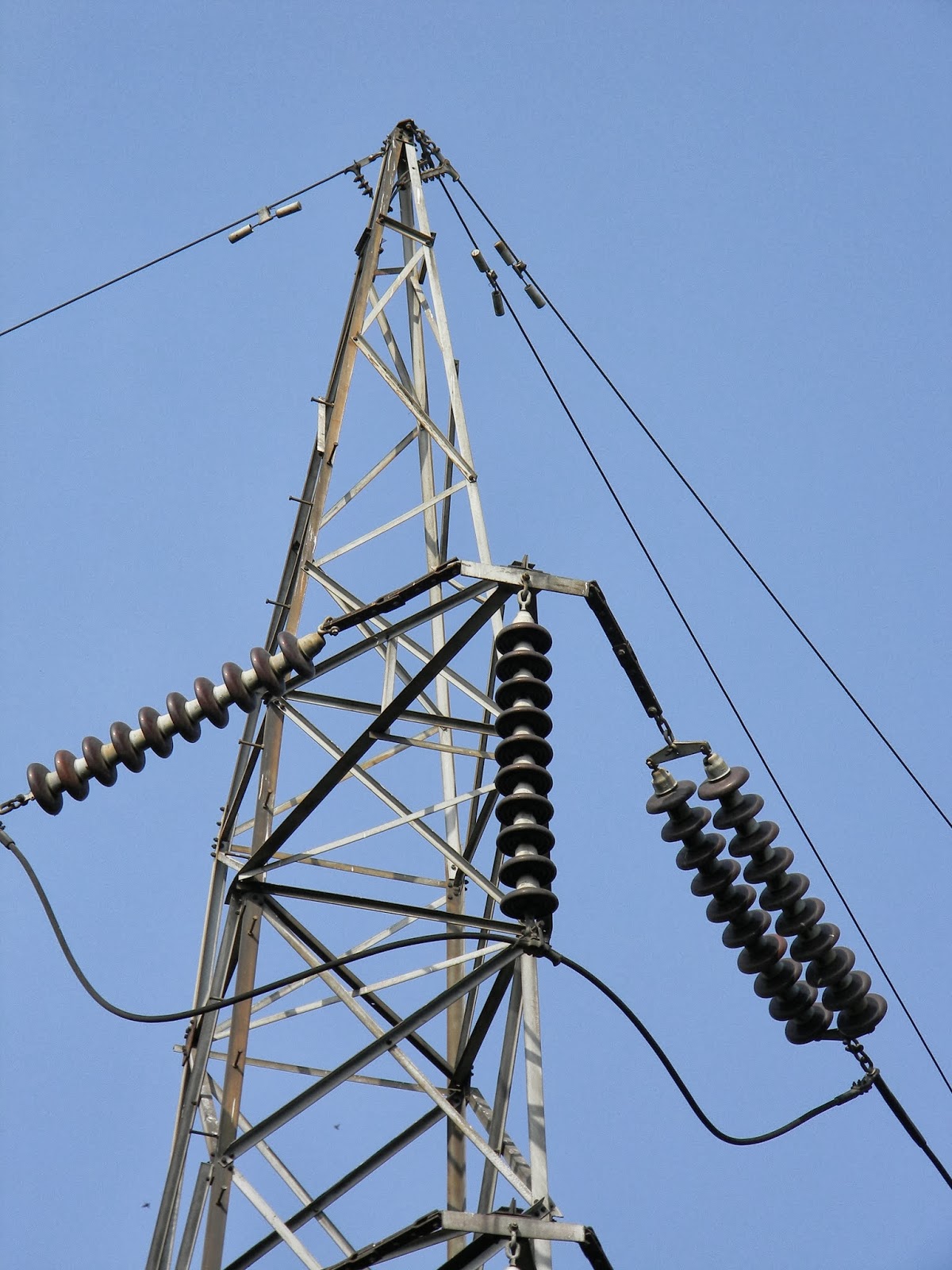
Power lines use a combination of conductors and insulators to carry electricity to houses and to avoid losing it into the ground.


Here's a video on how laser printers work.  More details can be found in your textbook on page 481-482.

Homework: Complete the Lab and worksheets.

Thursday, 17 October 2013

Oct. 17 – Charging Objects Lab

Today we worked on this laboratory activity:

Handout: Charging Objects Lab

I hope everyone was able to get all the observations for each of the three sections.  The lab is due tomorrow, so please answer all the questions at home and hand it in tomorrow.  You might have to search online to find information for the Application questions.

"But my observation is wrong!"

As you are working on the answers, you might notice that your observations don't always match what you might have expected.  This is perfectly normal in any experiment.  It is important to write down exactly what you observed rather than what you expect to see.  If you see something you don't expect, make a note of it.  Try to think of all the ways that this discrepancy might have occurred.  This is the best way to learn and the only way new discoveries are made!


Wednesday, 16 October 2013

Oct. 16 – Charging by Induction and Activities

Today we got a chance to try to charge different materials and see what happens.

Handout: Investigating Charges

This activity should prepare you for the lab tomorrow which will involve charging different materials.  I hope that through today's activities you got a sense of how difficult it is to charge objects and how much care you need to take to ensure that your experiments work well.

You also got your Chemistry Unit Test back.  Please let me know if you have any concerns with your mark!

I then talked about induction and how it works.  here are some brief notes:

Induction

Learning Goals: Understand how to charge without contact.

Success Criterial: You can complete the laboratory investigation tomorrow.

Induction is charging an object without contact.

Temporary:
 - A charged object is brought near a neutral object.
 - Charges separate in the neutral object.


Permanent:
 - A charged object is brought near a neutral object.
 - Charges separate in the neutral object.
 - Ground the neutral object.
 - Disconnect the object from the ground.

Details from your textbook:


Homework:

Prepare for your lab by reading the following section:

  • Read 11.6, P 486-487

Tuesday, 15 October 2013

Oct. 15 – Charging by Contact

Welcome back to class!  I hope everyone had a good long weekend.
We started with a bit of review to see if you remember what we did last week.  You should be able to identify what happens to charged objects and how they will behave.

Will these two objects attract, repel or not move at all?


Answer: The electrons (– charge) will move to one side and the overall result is that they will attract!

Charges can sometimes move around inside a neutral object and overall the two objects will attract.
Today we asked the question: How do objects become charged?

Learning Goals: Understand how objects gain or loose charge.

Success Criteria: You can identify how an object will be charged after contact or friction with another object.

How do Objects Get Charge

Charging by contact: 2 methods
 - Friction
 - Conduction

FRICTION

Rubbing two neutral materials together.
One loses electrons while one gains electrons.


How do we tell which one is positive or negative?
  - Electrostatic Series, P. 473


Ex: A cat plays in your hair.  Which one becomes positive?
A) Cat
B) Hair  <-- positive
C) neither
D) Don't know


How can I make two balloons attract each other?
- Rub one balloon on hair, balloon becomes negative.
- Rub the other balloon on polyester, it becomes positive.
- Since the charges are opposite, they balloons will attract each other.

CONDUCTION

A charged object comes in contact with another object.  Charges move around.

NOTE: ONLY electrons move.

 - The object that is MORE negative will lose electrons.
 - After contact, they will have the same charge.

The green shape is MORE negative, so it loses electrons.

The blue shape is MORE negative, so it loses electrons.

GROUNDING

A charged object comes into contact with a large reservoir of charge.   The charged object becomes neutral.

Ex: Your hand is charged.  You touch a doorknob, you lose charge to the door.

Ex: A balloon sticks to your hair.  You touch the balloon to the floor.  The balloon no longer sticks.

Homework

Read these sections in your textbook to see how electric charges can be applied.
  • Electrostatic Paint Sprayers: P. 470
  • Electrostatic Dusters: P. 475
  • Electrostatic Precipitators: P. 476


Answer these Questions

  • P. 477 #1-3, 5, 6

Thursday, 10 October 2013

Oct. 10 – Charges


New Unit: Electricity!

First of all, what is electricity?  Here's an example of electricity in nature:


Learning goals: Understand how to describe charge.

Success Criteria: You can use the idea of charges and static electricity to explain different situations.

Definitions
Electricity: The movement of charges.
Charges: An intrinsic property of matter.

  • Electrons are negatively charged, –
  • Protons are positively charged, +
  • Neutrons have no charge, 0
You can not see or feel charge, you can only tell how it interacts with other charges.

Law of Electric Charges

  • Like charges repel
         (+ repels +)
         (– repels –)
  • Opposite charges attract
         (+ attracts –)
         (– attracts +) 

Static Electricity 
When charges accumulate on an object.

  • An object with more electrons than protons becomes negatively charged.
  • An object with fewer electrons than protons becomes positively charged.
  • An object with the same number of electrons and protons is neutral.

We used the idea of charges attracting and repelling to explain what happens in these situations:

Charges accumulate in his hair.  All the charges are the same, so each hair repels the others.

The cat and ballon have opposite charges, so they attract each other.
Cat vs. Ballon Video: http://www.youtube.com/watch?v=TE2r0vjkXK0


Charges accumulate on the finger and jump to the door nearby.
This person uses the charges from the carpet going through his body to create a light show.
Static Wizard video: http://www.youtube.com/watch?v=8OePt0fSjqs

Finally we discussed the idea of induced charges.

Induced charge:

When a charged object comes near a neutral object, charges can separate in the neutral object.

I used an electroscope to demonstrate induced charges.
I also showed you how you can induced charges in water.

A similar experiment to what I showed you in class.
Homework
  • P. 471 #2-7

Have a great Thanksgiving weekend!